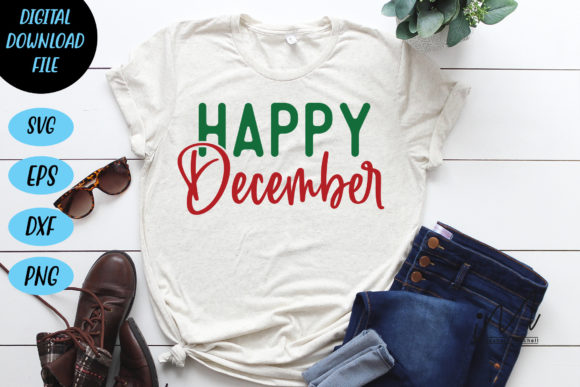
Happy December SVG Cut Files
A Designer’s First Look: Clean, Festive, and Ready for Stitching
As someone who’s digitized over 300 holiday embroidery files—and shipped embroidered totes, baby blankets, and boutique aprons for real clients—I opened Happy December SVG Cut Files expecting either charming simplicity or awkward spacing. What I found was a well-proportioned, mid-weight script that feels warm but not cutesy, seasonal but not dated. The letters sit comfortably on one baseline, with subtle swashes on the “H” and “D” that add personality without compromising stitchability. It’s not overly ornate—no fragile flourishes or micro-thin serifs—so it avoids common pitfalls in machine embroidery design: skipped stitches, thread breaks, or lost detail on textured fabric.
Real-World Use: From Tote Bag to Tea Towel
Last week, I prepped a small-batch holiday line for my local craft shop: embroidered canvas tote bags, organic cotton tea towels, and fleece-lined baby caps. I tested Happy December SVG Cut Files across all three. On the tote? Crisp and legible at 4.2” wide—ideal for center-chest placement. On the tea towel? Slightly larger (5”) gave it presence without overwhelming the linen blend. On the baby cap? Tricky—but it worked cleanly at 3.5” using a medium tear-away stabilizer and reduced top tension. No puckering, no letter collapse. That tells me this isn’t just a pretty PNG—it’s a functional embroidery file built for variation.
The clean vector structure (SVG, DXF, EPS) made resizing predictable. I scaled it down for a patch (2.75”) and up for a pillow cover (6.5”)—no jagged edges or distorted curves. And because the design includes a transparent PNG at 300 DPI, I dropped it straight into mockups for Etsy listings and Instagram previews. Customers responded strongly to the “handmade holiday” vibe—not flashy, not generic, just quietly confident.
Where It Shines—and Where to Pause
Happy December SVG Cut Files excels in applications where clarity and warmth matter more than complexity: personalized sweatshirt embroidery for school staff gifts, minimalist nursery decor, custom aprons for bakeries, or holiday-themed patches sewn onto denim jackets. Its balanced letter spacing holds up beautifully in satin stitch, and the moderate stroke weight ensures fill stitch areas won’t feel heavy or dense—even on lightweight cotton.
That said, I’d avoid using it *as-is* for stretchy fabrics like jersey knits without adjusting underlay or adding light cutaway stabilizer. On dark fabric, test thread colors carefully—the lowercase “e” and “m” have tight counters; some metallic or low-contrast threads can blur them. And while it scales well, don’t push below 2.25” on high-pile fleece or terry cloth—the inner curves of the “a” and “d” may lose definition.
It’s also not an applique design. There are no layered elements or reverse-cut outlines—so if you’re planning a holiday quilt block or multi-material patch, you’ll need to build those layers yourself. But as a standalone machine embroidery design? It’s honest, adaptable, and production-ready.
Design Notes Every Embroidery Professional Should Check
- Test first on scrap fabric—especially if stitching on textured weaves or curved surfaces like caps.
- Review stitch density in your embroidery software before sending to the machine. Dense fills can cause stiffness on baby items; looser fills may lack impact on tote bags.
- Confirm hoop size compatibility. At standard sizes (3.5”–5”), it fits most 4x4 and 5x7 hoops—but verify before batching.
- Inspect small details at actual stitch size: the crossbar on the “H,” the curve of the “c,” and the tail of the “y.” They hold up, but only if digitized thoughtfully (and this one is).
- Try black-and-white mockups to assess contrast and readability—this helps predict how customers will see it on product photos.
- Use proper stabilizer: medium tear-away for stable wovens, cutaway for knits or lightweight linens.
- Check licensing terms before selling finished products or reselling digital files—this listing doesn’t specify commercial use rights, so verify before scaling your craft business.
How It Elevates Your Handmade Product—and Your Customer’s Experience
When a customer orders a “Happy December” embroidered kitchen towel from your Etsy shop, they’re not just buying fabric—they’re buying intention, seasonality, and care. This design delivers that quietly. It reads as handmade, not mass-printed. It feels personal without being overly sentimental. That builds trust—especially for repeat buyers who recognize your consistent, thoughtful aesthetic.
I’ve seen too many holiday designs go overboard: snowflakes everywhere, glitter effects that don’t stitch, or fonts so thin they vanish after two washes. Happy December SVG Cut Files avoids all that. It supports brand consistency—whether you’re selling modern farmhouse aprons or gender-neutral baby onesies. And because it’s clean enough to pair with simple icons (a single holly leaf, a minimalist wreath), it works as part of a broader holiday collection—not just a one-off graphic.
Final Thought: A Reliable, Human-Centered Design Asset
If you’re an embroidery designer, Etsy seller, or small shop owner building holiday inventory, Happy December SVG Cut Files is less of a “trendy download” and more of a dependable tool—like a favorite needle or a trusted stabilizer. It doesn’t shout. It doesn’t overpromise. It simply works, across fabrics, projects, and customer expectations. In the Crafts category, where authenticity and execution matter more than flash, that’s exactly what makes a graphics asset worth keeping—and reusing—year after year.